Business forms
Smart forms that collect the right details first time.
Business Automation
Forms, approvals and alerts that run on their own, so your team stops copying and chasing.
What’s included
Choose the jobs to automate first. Each one is listed before we start.
Get a project estimate ↗Smart forms that collect the right details first time.
Requests routed, approved and recorded in one place.
Email, WhatsApp or app alerts at the right moment.
Reminders that make sure nothing is forgotten.
Weekly summaries generated automatically.
Automations that work across your existing software.
In practice
The same enquiry, handled two ways. Automation removes the copying, chasing and reminders, not the people.
Who it’s for
We watch how the work moves today. Then you get a clear plan and price before we automate anything.
Hover the example to see what’s behind it.
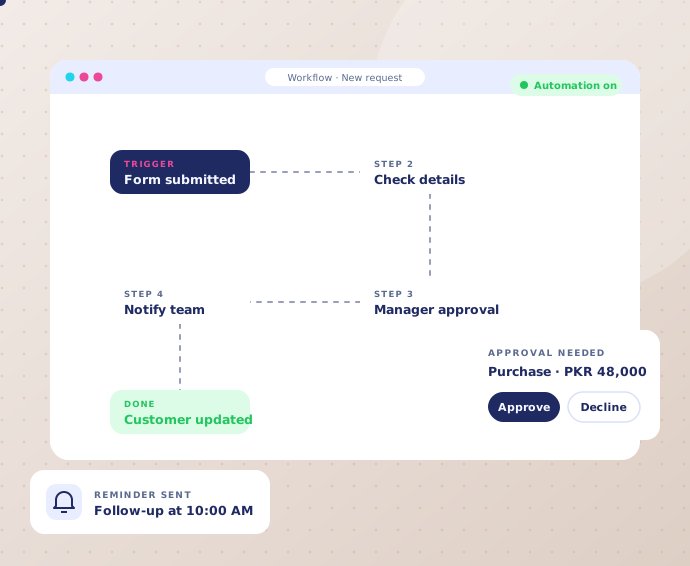
An enquiry from your website starts a defined workflow. Agree consent, validation and the information your team needs.
An assistant uses approved business information to clarify intent. Ambiguous or sensitive requests move to a person.
Validated details enter the correct record, with duplication rules and ownership agreed in advance.
Route a concise notification to the responsible team, with the context needed to take action.
Schedule an agreed follow-up with consent, cancellation rules and a human review path.
A map of how the work runs today and the first automation, ready to test.
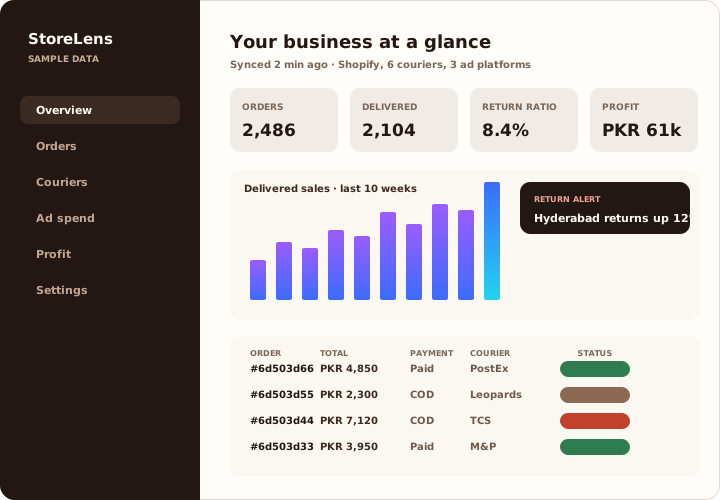
Our own SaaS syncs orders, tracks deliveries and flags rising returns automatically.
See our own SaaS ↗Where this comes from
We run our own e-commerce SaaS. Orders sync from Shopify, every parcel is tracked across six couriers, and rising returns trigger an alert, without anyone copying a single number. Keeping it running is our job every day, so we know which automations save real time and which ones only add moving parts.
What can actually be automated
Most businesses start with one or two of these. Each one is small on its own. Together they give back hours every week.
Every enquiry answered in seconds, tagged and sent to the right person. Usually the biggest win, because the business that replies first often wins the job.
A polite reminder on a schedule you set, stopping the moment the client replies.
Built from a short form, not copied from the last one, so an old client’s name never slips in.
The same setup steps every time, in the right order, without anyone having to remember them.
Sent after every finished job, to every customer, not only the ones you expect to be happy.
Fewer no-shows, and no reminder calls from you.
The conversation nobody likes having, handled on time and politely.
Enquiries, sources and results put together and sent to you, instead of you building them.
Courier status sent to your customers on WhatsApp or email, so they stop calling to ask.
Anything where a customer needs to feel a person decided: complaints, unusual quotes, anything a regulator expects a named person to sign. Automating those saves an hour and costs a relationship.
We also say no when the volume is too low. If you send four quotes a month, chase them yourself. The automation would cost more than the time it saves, and we would rather tell you that on the call.
The automations run on your accounts, under your logins, on tools you pay for directly and can cancel. Nothing is locked to us. If you stop working with us, it keeps running.
You get written notes on what runs and when, so anyone can pick it up. The honest measure is simple: how many hours a week you get back. That is the number we will ask you to judge us on.
How we work
Three steps, starting with one small automation you can test.
We write down who does what, and where time is lost.
Start with the biggest time-saver and test it with real examples.
Once it works, we add the next one and show your team how it runs.
Questions
The repetitive task that costs the most time or causes the most mistakes. We help you choose one useful first workflow.
No. Automation removes copying and chasing so your people can focus on decisions and customers.
Yes, in most cases. We build around the tools you already use wherever we can.
Connected services
Your next step
Tell us what you need. You get a clear first step and a price.